
In a world where meetings can feel as exciting as watching paint dry, virtual reality (VR) swoops in like a superhero with a cape made of pixels. Businesses are discovering that VR isn’t just for gamers anymore; it’s a game-changer for the corporate landscape. Imagine stepping into a virtual boardroom where your colleagues are just a headset away, and brainstorming feels less like a chore and more like an adventure.
From training sessions that transport employees to far-off locations to immersive product demos that leave clients dazzled, VR is redefining how companies operate. It’s not just about flashy tech; it’s about enhancing productivity and engagement in ways traditional methods can’t match. So, buckle up as we explore how VR is revolutionizing the business world, one headset at a time.
Overview of VR for Business
Virtual reality redefines how businesses operate, emphasizing immersive experiences that enhance various functions. Companies utilize VR for training, allowing employees to engage in realistic simulations. Effective onboarding programs leverage VR to prepare new hires for real-world scenarios, increasing knowledge retention.
Meetings transformed by VR create the sense of presence among remote teams. Participants feel as if they are in the same space, enabling higher levels of interaction and collaboration. This shift results in more productive discussions and decision-making processes.
Marketing strategies take advantage of VR by offering engaging product demonstrations. Customers experience products in a virtual setting, increasing understanding and emotional connection. Statistics show that brands using VR in marketing see a substantial rise in engagement rates.
Customer support can also benefit from virtual solutions. With VR, support teams provide guided assistance through immersive tutorials. This method reduces frustration and resolves issues more efficiently.
Research indicates that over 30% of companies already incorporate VR technologies in their operations. As its adoption grows, the potential for innovation and efficiency expands. VR’s continuous evolution positions it as a critical tool for future business practices.
The integration of VR into various business processes highlights its versatility and effectiveness. Organizations embracing this technology position themselves to lead in a competitive landscape, harnessing its full potential.
Benefits of VR for Business
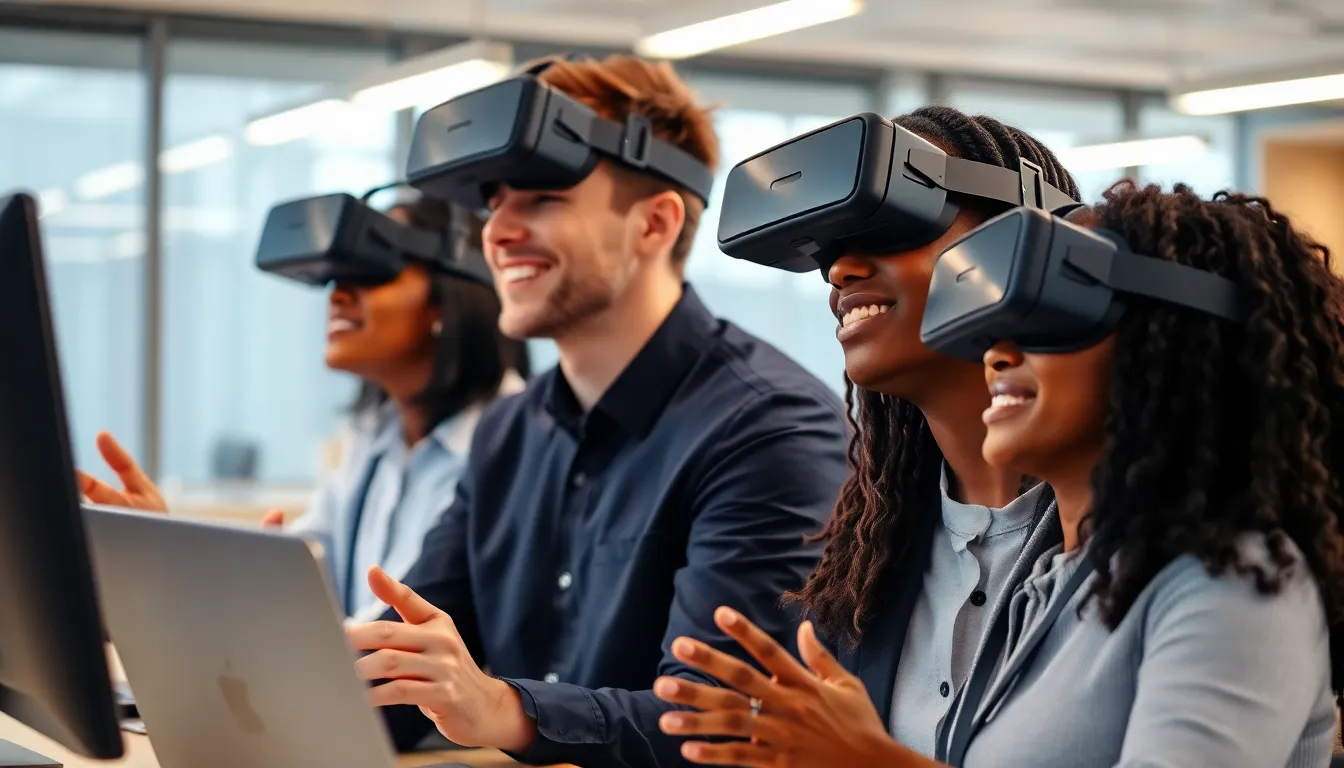
Virtual reality (VR) offers numerous advantages for organizations seeking innovation and efficiency. Its potential reshapes training, collaboration, and communication within the workplace.
Enhanced Training and Development
VR enhances training programs by providing realistic simulations. These immersive experiences boost knowledge retention, making onboarding more effective. Employees engage actively, which leads to better understanding and skill acquisition. Companies report increased confidence in new employees after VR training sessions. Research shows that learners retain 75% of information delivered through VR compared to traditional training methods. By using VR, businesses create safe environments for practice, allowing trial and error without real-world risks. Engaging training with VR ultimately drives performance improvement across teams.
Improved Collaboration and Communication
Improved collaboration stems from VR’s ability to create immersive environments for meetings. Teams located in different regions can interact as if they were in the same room, reducing feelings of isolation. Virtual spaces foster better communication, encouraging open discussions and brainstorming sessions. Studies reveal that productivity can increase by 15% when remote teams use VR for meetings. Enhancing connection leads to stronger relationships among colleagues. Ultimately, seamless collaboration through VR breaks down barriers and facilitates the sharing of ideas and solutions efficiently.
Applications of VR in Different Industries
Various industries are increasingly adopting VR technologies to enhance operations and improve efficiency.
Manufacturing and Engineering
Manufacturers utilize VR for immersive training scenarios that mimic real-world environments. Engaging simulations allow employees to practice skills safely, leading to increased competency. Engineers benefit from VR design reviews, enabling virtual walkthroughs of products before actual production. Reduced errors during the prototyping phase can save significant time and costs. Research indicates that the integration of VR in engineering reduces product development time by up to 30%. Companies can also visually assess layouts and workflows to optimize processes, demonstrating VR’s impact on operational efficiency.
Healthcare and Medicine
Healthcare professionals employ VR for surgical simulations, offering students and doctors realistic practice. Training in a risk-free environment enhances skills and confidence. Additionally, VR assists in patient rehabilitation, providing customized therapy experiences that improve engagement. Evidence shows that patients can recover faster when using VR during treatment. Virtual simulations also help medical staff prepare for emergency scenarios, heightening response skills and teamwork. As VR technology evolves, its presence in medical education and treatment continues to expand, improving patient outcomes and healthcare quality.
Real Estate and Architecture
Real estate agencies leverage VR for virtual property tours, allowing clients to explore listings from anywhere. Potential buyers can experience properties without physical visits, streamlining the buying process. Architects enhance design presentations by creating immersive walkthroughs of projects. Clients can visualize spaces and provide feedback early in the design stage, leading to higher satisfaction. Statistics indicate that properties showcased with VR receive 50% more inquiries. Furthermore, developers utilize VR to demonstrate concepts to investors, facilitating better decision-making and collaboration. This innovative approach significantly transforms how stakeholders interact with real estate projects.
Challenges of Implementing VR in Business
Implementing virtual reality in business presents several challenges that organizations must navigate to achieve success.
Cost and Resource Allocation
Costs associated with VR technology can be significant. Hardware expenses include headsets and high-performance computers, which may strain budgets. Additionally, companies need to invest in software development for tailored applications. Training employees on VR tools also requires financial and time resources. The overall commitment to VR can stretch existing resources thin, especially for small and medium enterprises. Strategic planning around resource allocation is vital for maximizing return on investment. Companies often explore partnerships or sponsorships to offset initial costs, thereby easing the financial burden while integrating VR into their operations.
Technical Limitations and Learning Curve
Technical challenges can hinder VR adoption in business settings. Hardware incompatibility may arise, complicating integration with existing systems. Networking issues can disrupt performance during critical applications. A learning curve exists for employees unfamiliar with VR technology, necessitating comprehensive training programs. Employees must adjust to immersive environments, affecting productivity during initial implementation stages. Effective training designs focus on user experience, improving familiarity with the tools. Companies enhance outcomes by providing ongoing support and resources, ensuring successful adoption of VR technologies in their workflows.
Future Trends in VR for Business
Emerging trends in VR for business are shaping the future landscape of corporate operations. Companies increasingly prioritize wearable VR technology, enabling more intuitive and accessible user experiences. Growth in this sector indicates that software solutions will evolve to support cross-device integration, enhancing collaboration between remote teams.
VR’s role in data visualization is expanding. Businesses use immersive environments to present complex data sets more effectively. Enhanced analytics tools will likely integrate with VR platforms, providing real-time insights and facilitating decision-making.
Training advancements within VR are transforming how employees learn. Not only are companies investing in realistic simulations, but they also focus on customizing training modules based on specific job functions. Statistically, organizations utilizing VR for tailored training report up to 40% faster learning times.
In marketing, VR campaigns will become increasingly interactive, offering consumers unique brand experiences that traditional methods can’t match. Companies leveraging augmented reality with VR will likely see higher customer engagement rates, driving sales conversions.
Customer service applications will continue to evolve as well. Integrating VR with AI chatbots can provide personalized support experiences. This approach enhances customer satisfaction by allowing immersive troubleshooting and product demonstrations.
Sustainability practices are also gaining traction within VR. Companies will explore how virtual environments can reduce physical resource consumption and energy usage. As a result, more organizations may adopt VR to minimize their carbon footprints while maintaining operational efficiency.
Overall, the future of VR in business appears bright. As technology advances, organizations will continue to innovate and adapt, leading to more efficient procedures and enhanced user experiences across various industries.
The integration of virtual reality into business practices is reshaping how organizations operate and engage with employees and clients. As VR technology continues to evolve its applications across various industries, companies are discovering new avenues for enhancing training and collaboration.
Despite the challenges associated with implementation, the potential benefits far outweigh the hurdles. By embracing VR, businesses can foster innovation and improve efficiency in ways that traditional methods simply can’t match.
Looking ahead, the future of VR in the corporate world promises even greater advancements, making it a crucial component for companies aiming to stay competitive and relevant in an ever-changing landscape.